
186,267 Indian students were studying in the US in 2016-2017.
The India-US nuclear deal was aimed at ending India's nuclear isolation and nuclear apartheid, recalls Rup Narayan Das.

Strategic consideration were the reasons behind frequent meetings between United States President Barack Obama and Prime Minister Narendra Modi, Chinese state-run media said on Wednesday and cautioned India that it cannot rise by "containing" China or picking one side against the other.

Experts said the tensions have added to a sense of apprehension in the United States, Europe and parts of Asia that China will engage in more aggressive behaviour in pursuit of its territorial interests, which in turn has raised the possibility of a serious and coordinated pushback by leading global players.

The US election campaign has provided plenty of ammunition for the CCP to make its case that its political system is superior.

India's main security concern now is an assertive China, which does not acknowledge its status as a global player, and not the increasingly decrepit state of Pakistan, according to an American think-tank.

'If you behave like a nail, the adversary will behave like a hammer.'
In recent years India-Japan relations have acquired rich economic content and strategic intents. Although the bilateral trade at $18 billion between the two countries is not very impressive and leaves much to be desired, the economic engagement between the two countries is both qualitatively and quantitatively noteworthy. India-Japan defence cooperation, however, has generated a lot interest among the strategic community in the context of rise of China. There has been a lot of speculation about India-Japan strategic partnership to hedge China, says Rup Narayan Das.
Professor Zha Daojiong speaks of the complex issues related to energy security, diplomacy and economics of the region.
China should deepen its defence ties with India, as the agreement reached by the two countries to resume joint military exercises still represented a 'low level of cooperation', the official media said on Wednesday.

In the test, a space rocket boosted a hypersonic glide vehicle, one capable of carrying a nuclear device, which circled the globe before impacting.
There will be always new areas for India and China to cooperate and collaborate, since they facing similar challengers, says China expert Dr Hu Shisheng.

Access to Sabang Port will allow the Indian Navy to dominate Malacca Strait more effectively, reports Ajai Shukla.
The intrusions into India were likely carried out by the PLA's better trained and equipped 'mobile operational units'.
'India will want a lot of help from the US, but it's not going to want US troops.'

Times have changed, situations have changed, but the basic nature of superpower geo-politics remains the same and so also India's diplomacy -- call it non-alignment, strategic autonomy or neutrality; it all depends on the time scale, notes Rup Narayan Das.
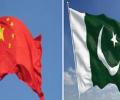
China on Thursday told Pakistan's new Prime Minister Shehbaz Sharif that it will always put its "all-weather ally" as a priority in its neighbourhood diplomacy as it praised his commitment to promote the USD 60 billion CPEC initiative.

Indian Army's reported plan to set up think-tanks focussing on China has evoked mixed reactions among scholars in Beijing with some calling it a positive move and others saying it showed that Indian security forces have identified the PLA as a "real strategic rival".
China has denied reports that Southeast Asian nations are building up their militaries and edging closer strategically to the United States as a hedge against the Communist nation's rise.The latest data released by the Stockholm International Peace Research Institute shows that weapon purchases in the Southeast Asian region almost doubled between 2005 and 2009.
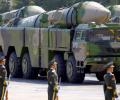
The 119 nearly identical construction sites, that could potentially house powerful weapons capable of reaching the American mainland, are similar to those seen at existing launch facilities for China's arsenal of nuclear-tipped ballistic missiles, the report said.
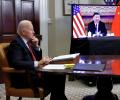
Washington is signalling to Delhi that it can rely on American support in any great game vis-a-vis China. Delhi shouldn't fall into the trap, argues Ambassador M K Bhadrakumar.

'If the Chinese military gets hold of some western sectors on the India-China boundary, it will give them added military advantage.'

The visit of Park Geun-Hye to India, though a symbolic one, will certainly give a further impetus to the strategic partnership between the two countries says Rup Narayan Das.
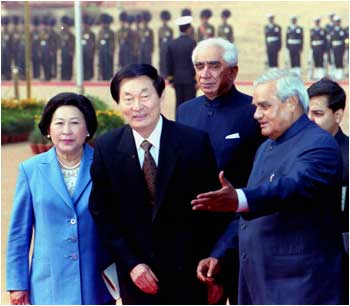
'He knew that a regime which believes that power flows from the barrel of the gun can only be handled from a position of comprehensive strength and not from a position of vulnerability and weakness,' says Rup Narayan Das.

'India has ramped up infrastructure on its side, so the Chinese military is finding Indian soldiers in locations where they are not used to seeing an Indian footprint,' points out Harsh V Pant.

The paper also includes musing that SARS -- which hit China in 2003 -- could have been a man-made bioweapon deliberately unleashed by "terrorists".

Indian officials said Doval's visit will be rescheduled as he is preoccupied with the handling of the Pathankot incident.

Although the credit for acquiring the technological skill must be given to India's outstanding nuclear scientists, the decision to go nuclear was a political one that entailed clarity of vision, courage and resolve, points out Rup Narayan Das.
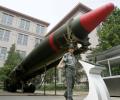
Despite four disarmament section talks and six strategic dialogues between the two foreign ministries, China's intransigence on recognising Indian nuclear status resulted in no confidence building measures in the nuclear field between the two, says Srikanth Kondapalli.

'The world is watching carefully. The choices India makes today have consequences beyond its borders.'
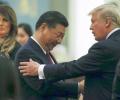
'While many Chinese policy makers dismiss the political, economic and technological component of US-India relations, they express caution on the defence-related ties which also happens to be a major driver in US-India relations,' explains China expert Srikanth Kondapalli.

'By extending its support to the LeT, China is not helping the cause of containment and eventual destruction of radicalism and terror.'
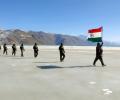
India has told China not to "shift goalposts" and "confuse" managing the border affairs and restoring peace at the frontiers with the larger issue of the resolution of the boundary question, which is dealt with by different designated mechanisms.

A new version of jihad is attracting "small but steady stream" of Indians to join Islamic State movement in Syria, Former National Security Advisor M K Narayanan has warned.

The BRICS summit made clear that China's support for Pakistan is unwavering. China will continue to pressure India to ease tensions with Pakistan and resolve the Kashmir dispute.

President Pranab's four-day visit to China that saw him meeting the top Chinese leadership and discussing the sticky boundary issue and cooperation in combating terrorism besides the need for a predictable nuclear regime.

'During his visit to Vietnam on September 3 -- the first visit by an Indian prime minister in 15 years -- Modi will notice the widespread anti-China sentiment in that country.'
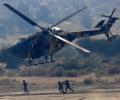
'Given the present force levels, India cannot fight and win.' 'India can't hope to terminate the conflict on India's terms and impose the nation's will upon the adversaries,' says Brigadier Gurmeet Kanwal (retd).
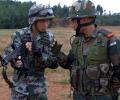
'Leaders of the two nations have reportedly agreed to set up a hotline between their respective military headquarters,' state-run Global Times daily reported on Wednesday.

Chinese Ambassador Sun Weidong has said peace and tranquility in the border areas with India is important but it is not the "whole story" of the bilateral relations and that the current status of the ties is obviously not in the fundamental interest of either side, remarks that came amid the Ladakh military standoff.
